

The simplest method to prevent condensation of water droplets from air is to maintain the temperature above the dew point. An alternative method is to use a dehumidifier.
Dew Point Control
The dew point of humid air is the temperature to which it must be cooled to become saturated with water vapor. In other words, at a given relative humidity and atmospheric pressure, water droplets will begin to form (condense) when the air temperature cools to the dew point. See Wikipedia – Dew Point.
The following chart shows dew point temperature as a function of air temperature and relative humidity.
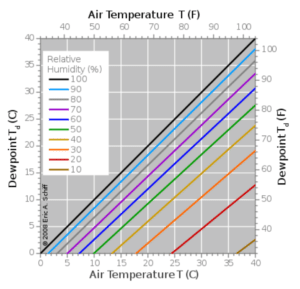
Chart 1 – Dependence of Dew Point to Air Temperature at Several Levels of Humidity
Perhaps the most common display of this phenomenon is the presence of morning dew. During the day, air is heated by the sun and gains relative humidity by evaporation of nearby water. During the evening, the air temperature cools until it reaches the dew point and forms condensed water droplets on surfaces such as grass and car windows.
If condensing water is a concern in a TV enclosure due to high relative humidity and variable air temperatures, condensation can be prevented by adding a temperature-controlled heater in the enclosure.
To determine the set-point temperature inside the enclosure, some assumptions must be made regarding the maximum air temperature and maximum relative humidity. Let’s look at a few examples:
Example 1 – Normal
Let’s take an example where a TV enclosure is operating in a temperature-controlled environment between 65°F – 80°F and the relative humidity can range from 60 % to 80 %. We are trying to determine the temperature that must be maintained in the TV enclosure to prevent condensation from humidity. In this case, the highest dew point temperature results from 80°F and 80 % relative humidity. From Chart 1, we see that the dew point under this condition is about 75°F. To prevent condensation in a TV enclosure in this environment, we would select a heater that would be set to keep the enclosure at a minimum of 75°F. In actual application, the set-temperature should be set 5 – 10 degrees higher than the highest dew point, say 85°F.
Example 2 – High Humidity
In a more extreme example, let’s say the temperature can range from 50°F – 100°F and the relative humidity can range from 50 % to 100 %. In this case, the maximum dew point temperature would be 100°F. We would select a heater and controller that would maintain the temperature above 100°F. In this extreme example, the high temperature set-point could cause its own set of problems for the TV and other electronics. A standard TV typically has a high temperature operating level of 104°F. In this extreme example, three solutions are available:
- Employ a high-temperature TV specified to operate at temperatures up to 110°F – 120°F and set the heater controls to 105°F – 110°F;
- Install a TV rated for outdoor use that can handle condensing water and prevent damage;
- Install a dehumidifier unit onto the enclosure.
Outdoor Rated TV
There are several companies that offer outdoor rated TVs. These TVs are built with special care to protect them from ingress of water that might damage electrical components. They are significantly more expensive than standard TVs, but may be warranted in extreme humidity conditions. SYLVOX and Sunbright are two brand examples.
Dehumidifier
There are several types of commercially available dehumidifiers. See Wikipedia – Dehumidifier. Generally, the concept works based on dew point as described previously. Air from the TV enclosure can be blown into a separate chamber and cooled across a cold surface where water droplets would accumulate and be removed. At this point, the air would be at its saturation temperature and would need to be reheated prior to blowing back into the TV enclosure to prevent condensation. This solution is costly and complex and should only be used if a high-temperature or outdoor TV cannot be employed.
Conclusion
Humidity in a TV enclosure is usually only a problem if humidity condenses to water droplets on or in the TV or other electronics. Humidity can usually be controlled with the simple and inexpensive use of a temperature-controlled heater. In extreme cases, a high-temperature or outdoor TV may be required, or the addition of a dehumidifier.


